

Table of Contents
- Why Your Mind Races During Meditation (And Why That's Normal)
- Step 1: Choose an Anchor for Your Racing Mind Meditation
- Step 2: Label Thoughts Without Judgment
- Step 3: Troubleshoot Specific Thought Patterns
- Grounding Exercises for an Overactive Mind
- Meditation for Anxiety and Overthinking: What Actually Helps
- How Long Should You Meditate to Calm Your Mind?
- Post-Meditation Integration: Carrying Calm Into Your Day
- Frequently Asked Questions
Last Updated: August 30, 2026
Why Your Mind Races During Meditation (And Why That's Normal)
Meditating with a racing mind is not a sign that you're doing it wrong. A busy mind during meditation is not a failure state, it's the starting point. The mind produces thoughts constantly. When you sit down to meditate and become aware of that internal dialogue, you haven't created the noise. You've simply gotten quiet enough to hear it.
The Nervous System's Role in Mental Chatter
Mental chatter during meditation is largely a product of your nervous system doing exactly what it was designed to do. The brain's default mode network, a set of interconnected regions active when you're not focused on an external task, becomes highly active the moment you stop directing your attention outward. According to National Institutes of Health research on the default mode network, this network is associated with self-referential thinking, mind-wandering, and mental replay of past events.
For most of human history, a vigilant, anticipatory mind was a survival advantage. The problem is that this same system generates anxiety, rumination, and worry loops in situations that don't require an emergency response. Stress management through meditation works precisely because it gives the nervous system a different signal, but it takes practice before the system believes that signal.
Physiological Feedback Loops That Keep Thoughts Spinning
Racing thoughts and physiological arousal form a feedback loop: anxious thoughts trigger a mild stress response, which produces physical tension, which the brain interprets as confirmation that something is wrong, which generates more anxious thoughts. The good news is that the loop runs in both directions. Deliberately slowing your breathing or releasing physical tension can interrupt the cycle from the body's end, making cognitive stillness more accessible even when your thoughts feel out of control.
Step 1: Choose an Anchor for Your Racing Mind Meditation
The most effective first step in meditating with a racing mind is selecting a single anchor, a focal point your attention can return to each time it wanders. Without an anchor, the instruction to "clear your mind" is meaningless. With one, every wandering thought becomes an opportunity to practice gentle redirection.
Using the Breath as Your Primary Focal Point
The breath is the most widely used anchor in mindfulness practice. It's always present, rhythmic, and produces physical sensations you can observe without analyzing them. Rhythmic breathing naturally activates the parasympathetic nervous system, which counteracts the fight-or-flight arousal that keeps thoughts spinning.
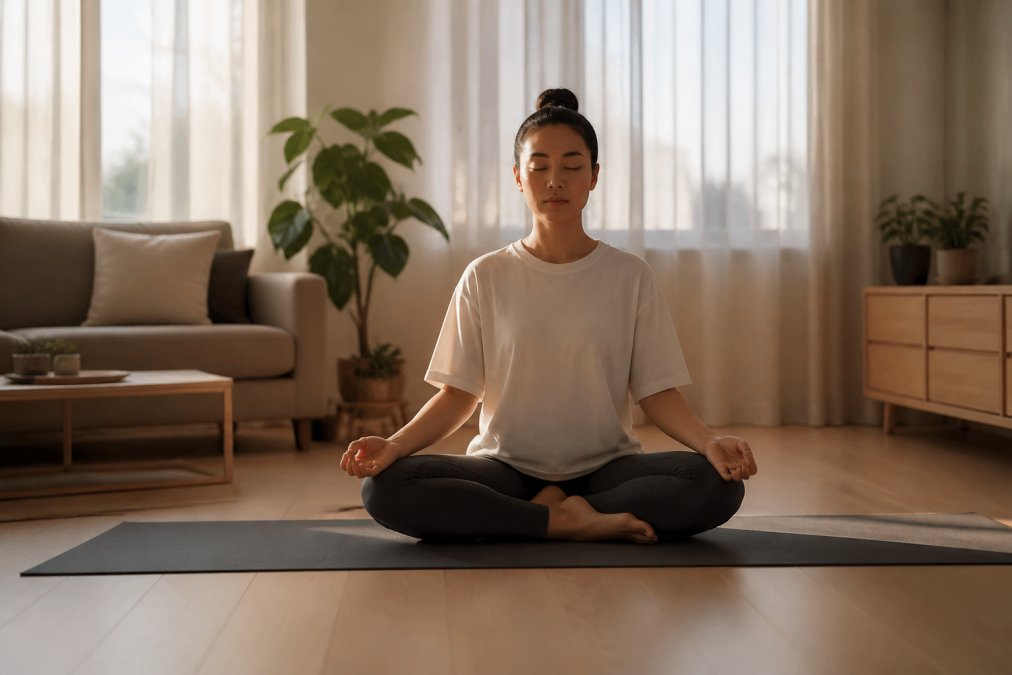
A practical breathing exercise for an overactive mind:
- Sit comfortably with your spine upright but not rigid.
- Close your eyes or soften your gaze toward the floor.
- Breathe in through your nose for a count of four.
- Hold gently for a count of two.
- Exhale slowly through your mouth for a count of six.
- Notice the physical sensation of air entering and leaving the body.
- When your attention drifts, return to step six without comment.
The extended exhale is deliberate. A longer exhale than inhale activates the vagus nerve and signals safety to the nervous system, helping break the physiological feedback loop.
Body Sensations and Sensory Engagement as Alternatives
The breath doesn't work for everyone. People with anxiety disorders or a history of breath-focused panic sometimes find that paying attention to breathing amplifies distress rather than reducing it. If breath focus makes you feel worse, switch your anchor.
Effective alternatives include physical contact points (the weight of your hands on your thighs, the pressure of your feet on the floor), sound (a distant ambient sound used as a neutral focal point), or temperature (the slight coolness of air entering the nostrils). Sensory engagement grounds attention in the present moment without requiring breath manipulation.
Step 2: Label Thoughts Without Judgment
Thought labeling is a specific cognitive strategy drawn from mindfulness-based approaches. When a thought arises, silently name its category: "planning," "worrying," "remembering," "judging." Then return to your anchor. You're not analyzing the thought or deciding whether it's valid, simply noting its type and letting it pass.
This works because labeling engages the prefrontal cortex, the brain's regulatory center, which helps modulate the emotional charge of the thought. As documented in research on affect labeling and emotional regulation, naming an emotion or thought pattern tends to reduce its intensity. If you can't find the right label, "thinking" covers everything. The point is non-judgmental awareness, not accurate categorization.
Step 3: Troubleshoot Specific Thought Patterns
Not all racing thoughts are the same. Worry loops, future-focused anxiety, and past-event replays each respond to slightly different strategies.
Worry Loops and Future-Focused Anxiety
Worry loops are characterized by repetitive, forward-looking thoughts cycling through worst-case scenarios. The mind is trying to solve a problem that hasn't happened yet. The most effective approach is brief acknowledgment before returning to your anchor. Silently say: "I hear you. I'll think about this later." Many practitioners find it helpful to keep a notepad nearby. Writing down the worry before sitting removes the mind's compulsion to hold onto it.
Replaying Past Events
Replaying past events reflects the brain's attempt to reprocess and resolve incomplete emotional experiences. During meditation, treat these replays with deliberate self-compassion. Acknowledge that the event happened, notice any physical tension it produces, then gently redirect to your anchor. Forcing these thoughts away tends to amplify them.
Grounding Exercises for an Overactive Mind
Grounding exercises work by anchoring attention to immediate physical reality, bypassing the cognitive layer where most racing thoughts live. These techniques are particularly useful when the mind is too activated to settle into breath-focused practice.
Explore the Mindful Meditation Series →
Progressive Muscle Relaxation
Progressive muscle relaxation involves tensing and releasing muscle groups in sequence, typically starting from the feet and moving upward. The deliberate physical tension followed by release produces a contrast that the nervous system registers as relief.
A simplified version: sit or lie down comfortably, inhale and tense your feet and calves for five seconds, exhale and release completely, then move to your thighs and repeat through abdomen, hands, arms, shoulders, and face. After completing the sequence, rest in stillness for two to five minutes. According to American Psychological Association's overview of relaxation techniques, progressive muscle relaxation is one of the most consistently supported behavioral interventions for reducing physiological arousal associated with anxiety.
Moving Meditation and Sensory Walks
The expectation that meditation requires stillness is one of the biggest barriers for people with overactive minds. Moving meditation, whether walking, gentle yoga, or mindful dishwashing, is a legitimate and often more accessible form of practice. During a sensory walk, the anchor shifts to physical movement and environmental input. Notice the sensation of each footstep, observe what you see without narrating it, feel the temperature of the air. This sensory engagement keeps attention occupied enough that the default mode network has less space to generate mental chatter.

Meditation for Anxiety and Overthinking: What Actually Helps
Meditation for anxiety and overthinking is not a single technique, it's a set of practices that need to be matched to the specific presentation of the problem. Short, frequent sessions outperform long, infrequent ones for anxious practitioners. A five-minute practice done daily produces more lasting change than a forty-minute session done once a week, because neuroplasticity depends on consistency rather than intensity. Guided meditation can also be particularly effective for anxiety and overthinking because an external voice provides a ready-made anchor, reducing the cognitive effort required to self-direct attention.
Contraindications: When to Adjust Your Approach
Meditation is broadly safe, but there are situations where a standard approach needs modification or professional support. Acute trauma or PTSD may require open-eye, externally anchored techniques rather than closed-eye practice. Severe anxiety disorders may benefit from external anchors like sound or visual objects rather than breath awareness. Depersonalization or dissociation may worsen with inward-focused practice; grounding exercises with strong sensory components are more appropriate. The recommendation is not to avoid meditation but to seek guidance from a qualified mental health professional who can tailor the approach. As noted in guidance from the National Center for Complementary and Integrative Health, mindfulness practices are generally well-tolerated but benefit from professional support in clinical populations.
How Long Should You Meditate to Calm Your Mind?
How long you should meditate to calm your mind depends less on a fixed duration and more on consistency. For most beginners dealing with racing thoughts, two to five minutes of genuine practice is more valuable than twenty minutes of frustrated mind-wandering.
A practical progression:
| Stage | Duration | Frequency | Focus |
|---|---|---|---|
| Week 1-2 | 2-5 minutes | Daily | Anchor selection and basic labeling |
| Week 3-4 | 5-10 minutes | Daily | Sustaining attention through thought labeling |
| Month 2 | 10-15 minutes | 5-6 days per week | Troubleshooting specific thought patterns |
| Month 3+ | 15-20 minutes | 5-6 days per week | Integration and deepening |
The goal is not to reach a state of no thoughts. The goal is to shorten the gap between getting lost in thought and noticing you've gotten lost. Over time, that gap narrows. That's the actual skill being trained.
Post-Meditation Integration: Carrying Calm Into Your Day
Post-meditation integration is the part of practice that most guides ignore entirely. The meditative state you cultivate during a session doesn't have to evaporate the moment you open your eyes.
Before standing up, take thirty seconds to notice how your body feels. Observe the quality of your attention. Set a brief intention for how you want to engage with the next hour. This is a bridge between the focused awareness you've built and the environment you're about to re-enter.
Carrying that awareness into daily activities is where neuroplasticity actually compounds. Washing dishes with full sensory attention, listening without mentally composing your response, noticing the physical sensation of walking between rooms, these micro-practices reinforce the same neural pathways you're building during formal sitting practice. Formal practice is training for informal practice. The session teaches the skill. The rest of the day is where you apply it.
Racing thoughts during meditation are not the enemy. They're the material you're working with. The challenge isn't silencing the mind; it's learning to relate to mental activity differently. Prosemakers offers a progressive series that meets you where you are and builds genuine, sustainable awareness over time. Explore the Mindful Meditation Series and start with a practice that's designed for the mind you actually have, not the quiet one you wish you had.
Frequently Asked Questions
Q: Can meditation make racing thoughts worse?
A: For most people, racing thoughts during meditation are temporary and settle with consistent practice. However, if sitting quietly triggers intense anxiety, panic, or intrusive thoughts that feel unmanageable, a seated practice may not be the right starting point. Grounding exercises, progressive muscle relaxation, or movement-based practices are gentler entry points. Anyone experiencing severe anxiety or trauma responses should speak with a mental health professional before starting a meditation routine.
Q: How do I meditate when my mind won't stop?
A: Start by accepting that a busy mind is not a failed meditation. Choose a simple anchor, such as the physical sensation of your breath at the nostrils or belly, and return to it each time you notice your attention has drifted. Thought-labeling helps too: silently note 'planning' or 'worrying' and redirect without criticism. Short sessions of two to five minutes are more sustainable than forcing twenty-minute sits when meditating with a racing mind.
Q: How long should I meditate to calm my mind?
A: Research suggests even brief daily sessions, as short as five to ten minutes, can support anxiety reduction and improve attention over time. Consistency matters more than duration. Starting with two-minute sessions and gradually extending to ten or fifteen minutes as focus improves is a practical approach. Meditating with a racing mind becomes easier as the nervous system learns to associate the practice with safety and stillness, a process that typically takes several weeks of regular practice.
Q: Is a racing mind a sign of anxiety or ADHD?
A: A racing mind during meditation is common and does not automatically indicate a clinical condition. Stress, poor sleep, caffeine, and an unfamiliar practice environment all contribute to mental chatter. Persistent racing thoughts that interfere with daily life, sleep, or work may warrant a conversation with a healthcare provider, since conditions like generalized anxiety disorder or ADHD can involve dysregulated attention. A meditation practice can complement professional support but is not a substitute for diagnosis or treatment.
This article was written using GrandRanker
0 comments