

Table of Contents
- Why Perfectionism Sabotages Your Meditation Practice
- Meditating With a Racing Mind: What Actually Happens
- How Long Should a Beginner Meditate Each Day
- The Role of Breath Awareness and Letting Go
- Simple Meditation Techniques for Daily Life
- Building Consistency Without the Pressure
- Your Failed Session Recovery Protocol
- Building a Sustainable Meditation Routine
- Frequently Asked Questions
Last Updated: September 3, 2026
Why Perfectionism Sabotages Your Meditation Practice
Perfectionism kills meditation practice quietly. You sit down, your mind floods with thoughts, and you decide you've failed before the session begins. This cycle repeats until you quit, convinced meditation isn't for you.
The truth is simpler: your expectations are working against you. A non-perfectionist approach reframes the entire practice. Instead of chasing a "perfect" session with a blank mind, you're learning to notice what's actually happening, racing thoughts, distractions, restlessness, and practicing acceptance of it all.

Perfectionism creates a false standard. You've likely internalized meditation as serene, effortless, and mentally silent. When your experience doesn't match, you interpret it as failure. But this standard doesn't exist in actual practice. Even experienced meditators work with busy minds. The difference is they've learned not to judge themselves for it.
At Prosemakers, we understand that those who abandon their practice often cite perfectionism as the reason. Those who stick with it have let go of the need to perform meditation correctly. They simply show up and practice.
Meditating With a Racing Mind: What Actually Happens
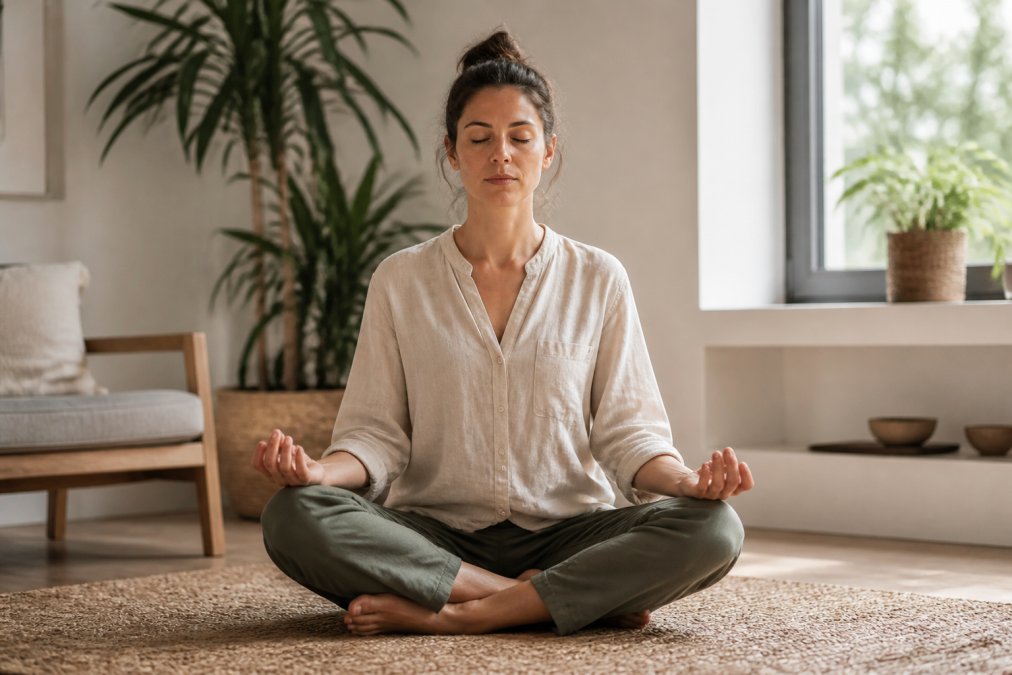
A racing mind during meditation isn't a problem to solve, it's the actual practice itself. Noticing that your mind is racing IS the meditation.
When thoughts flood in, that's not interference. That's you becoming aware of what your mind actually does all day long. You're not failing. You're finally paying attention.
Neurologically, your brain is designed to generate thoughts. When you meditate, you're not stopping this process, you're observing it without judgment. The moment you notice you've been lost in thought and gently return your attention to your breath, you've completed a successful cycle. Each return strengthens your ability to notice and redirect attention.
The non-perfectionist approach accepts this reality. You expect your mind to wander. When it happens dozens of times in a ten-minute session, you treat it as the practice, not as evidence of failure.
How Long Should a Beginner Meditate Each Day
The ideal duration for a beginner is between 5 and 10 minutes per day. This is long enough to experience genuine practice but short enough to sustain consistently without it feeling like an obligation.
Many beginners commit to 20 or 30 minutes because they believe that's what "real" meditation looks like. They last two weeks, then quit. A consistent 5-minute practice beats an inconsistent 30-minute one every time.
Research on habit formation shows consistency matters far more than duration. A daily practice, no matter how brief, builds neural pathways and creates behavioral momentum. Starting with 5 minutes allows you to establish the habit first. Once meditating feels normal, you can gradually extend the duration if you want to.
For busy professionals and high-stress individuals, even 5 minutes creates measurable shifts in attention regulation and emotional response. You're building a foundation, not achieving enlightenment in your first month.
The Role of Breath Awareness and Letting Go
Breath awareness is the anchor for a non-perfectionist meditation practice. Your breath is always available and never requires you to perform or achieve anything.
When you focus on your breath, you're simply noticing the physical sensation of breath moving in and out, the coolness of the inhale, the warmth of the exhale, the slight pause between them. This simple act of noticing is the entire practice.
Letting go is the counterpart to breath awareness. As thoughts arise, you practice releasing them without judgment. You notice the thought, acknowledge it, and return to the breath. This isn't about forcing the thought away. It's about not gripping it, not following it, not building a story around it.
Many meditators struggle because they expect letting go to feel like effort. It doesn't. Letting go is the absence of effort, the moment you stop trying to control your experience and simply allow it to be what it is.
In a non-perfectionist practice, you're not aiming for thoughts to disappear. You're practicing the skill of noticing thoughts without being controlled by them. This skill transfers directly to daily life. When anxious thoughts arise at work, you recognize them without being hijacked by them.
According to research from the National Center for Complementary and Integrative Health, consistent breath-focused meditation shows measurable effects on attention regulation and stress response. You're training your brain to notice and redirect attention, which is exactly what you need when intrusive thoughts appear in daily life.

Simple Meditation Techniques for Daily Life
The best meditation techniques are the ones you'll actually use.
Seated breath meditation. Sit comfortably on a chair, cushion, or bench. Close your eyes or soften your gaze downward. Notice your breath without trying to change it. When your mind wanders, gently return attention to the breath. That's the entire technique.
Walking meditation. Walk slowly and deliberately. Feel each footfall and the sensation of your legs moving through space. When your mind wanders to your to-do list or worries, bring it back to the physical sensation of walking. You can do this anywhere.
Body scan meditation. Lie down or sit comfortably. Mentally scan from your toes upward, noticing sensations in each area without trying to change them. This technique is particularly useful for people whose minds race, because it gives attention something concrete to focus on.
Eating meditation. Choose one meal or snack per day and eat it with full attention. Notice the colors, textures, smells, and tastes. Chew slowly. This is meditation disguised as a normal activity.
The non-perfectionist approach means you choose the technique that fits your life. If sitting still feels impossible, walk. If you're skeptical about formal practice, eat mindfully. The technique matters less than consistency.
Explore the Mindful Meditation Series →
Building Consistency Without the Pressure
Consistency is the real work of meditation, and it has nothing to do with willpower. It's about removing friction and making the practice automatic.
Anchor your practice to an existing habit. Meditate right after your morning coffee, before you check your phone, or immediately after brushing your teeth. You're not adding something new, you're attaching meditation to something you already do.
Set a specific time and place. Your brain loves routine. If you meditate in the same spot at the same time each day, the habit becomes self-reinforcing.
Lower the barrier to entry. If your practice requires finding a quiet room, lighting a candle, and clearing your mind, you've created friction. Instead, meditate wherever you are. Friction kills consistency faster than anything else.
Track it visually. A simple calendar where you mark off each day you meditate creates momentum. You're not tracking quality, just whether you did it. This removes perfectionism from the equation.
Your brain changes through repeated practice, not perfect practice. Each session, no matter how chaotic, strengthens your capacity for attention and self-awareness. Over weeks and months, this compounds into measurable shifts in how you respond to stress and focus at work.
Your Failed Session Recovery Protocol
Every meditator has failed sessions. Your response to failure determines whether you continue or quit.
Step 1: Normalize it. A failed session isn't evidence that meditation doesn't work for you. It's evidence that you're human. This is normal.
Step 2: Don't compensate. The moment you miss a session, your brain wants to make it up by meditating longer tomorrow. Resist this. Simply return to your normal practice the next day.
Step 3: Identify the actual barrier. Was the session failed because you were tired? Because your environment was noisy? Because you meditated at the wrong time of day? The barrier is usually something practical. Address it. If you're too tired in the evening, meditate in the morning.
Step 4: Reframe the session. Even a "failed" session where you sat for 5 minutes and felt restless the entire time is still practice. You practiced noticing restlessness without judgment. The failure is in your expectation, not in what you did.
According to research from the American Psychological Association, resilience and the ability to recover from setbacks are stronger predictors of long-term behavioral change than initial motivation. Your ability to sit down again after a failed session is more important than never having a failed session.
Building a Sustainable Meditation Routine
A sustainable routine survives real life, work stress, family demands, travel, and illness.
Start small. Five minutes is not a compromise. It's the foundation. You can always extend later, but starting with a duration you can maintain consistently builds the habit first.
Choose a trigger. Your meditation happens right after something else you already do. This removes the decision-making burden.
Expect your mind to be busy. A racing mind is the normal state of human consciousness. Every time you notice your mind has wandered and gently return to the breath, you've completed a successful cycle.
Be honest about what fits your life. If you travel frequently, walking meditation might be more realistic than seated practice. The best practice is the one you'll actually do.
The Prosemakers Mindful Meditation Series is designed specifically for this non-perfectionist approach. Mindful Meditation Made Easy: Your Step-By-Step Guide breaks down the practice into manageable steps and removes the mystique that makes meditation feel intimidating. Meditation and Your Brain: Breathe Your Way to Well-Being explains the neuroscience behind what happens during meditation, which helps many people understand that a busy mind is not a sign of failure.

For those looking for a complete progression, The Mindful Meditation Series, Complete 4-Book Bundle provides a comprehensive path from foundational practice through deeper understanding of how meditation reshapes attention and emotional response.
| Component | Duration | Frequency | Purpose |
|---|---|---|---|
| Daily seated meditation | 5-10 minutes | Every day | Build attention and breath awareness |
| Walking meditation | 5-15 minutes | 2-3 times per week | Practice presence in motion |
| Eating meditation | 5-10 minutes | Once per day | Anchor practice to existing activity |
| Reflection journaling | 3-5 minutes | 2-3 times per week | Track patterns and insights |
The goal of a non-perfectionist approach to daily meditation isn't to achieve a transcendent state or empty your mind. It's to build a sustainable practice that fits into your actual life and gradually strengthens your capacity for attention, self-awareness, and emotional regulation. Start with five minutes. Show up consistently. Accept that your mind will wander. Over weeks and months, the simple act of returning your attention again and again creates measurable shifts in how you respond to stress, focus at work, and relate to your own thoughts. This is how meditation works, not through perfection, but through practice.
Frequently Asked Questions
Q: Is it okay if my mind wanders during meditation?
A: Yes, mind wandering is not failure. Your brain is designed to think. In non-perfectionist meditation, noticing your mind has wandered and gently returning attention is the actual practice, not a mistake. Each time you redirect your focus, you're strengthening attention regulation. Expecting your mind to be blank is the perfectionist trap that causes most people to quit.
Q: How long should a beginner meditate to see real results?
A: Start with 5-10 minutes daily. Research on neuroplasticity shows consistency matters more than duration. A 5-minute daily habit can help rewire your brain's attention networks. Beginners who commit to shorter, regular practice build sustainable habits and may notice improved focus and emotional regulation.
Q: What should I do if I feel like I'm failing at meditation?
A: Reframe what failure means. A 'failed' session, where your mind raced, you felt restless, or you quit early, is still valuable practice. The non-perfectionist approach treats every session as data, not judgment. Use journaling to reflect on what happened without criticism. Notice what triggered restlessness and adjust your environment or timing next time. Progress comes from showing up, not from perfect performance.
Q: Can simple meditation techniques actually reduce stress for busy people?
A: Yes. Micro-meditations, 2-3 minute breathing practices during breaks, can help activate your parasympathetic nervous system and may contribute to lower cortisol levels. Even brief daily techniques like grounding or body scans can support improved emotional regulation and mental clarity. The key is consistency and acceptance that short, imperfect practice beats skipping meditation because you don't have 30 minutes.
This article was written using GrandRanker

0 comments